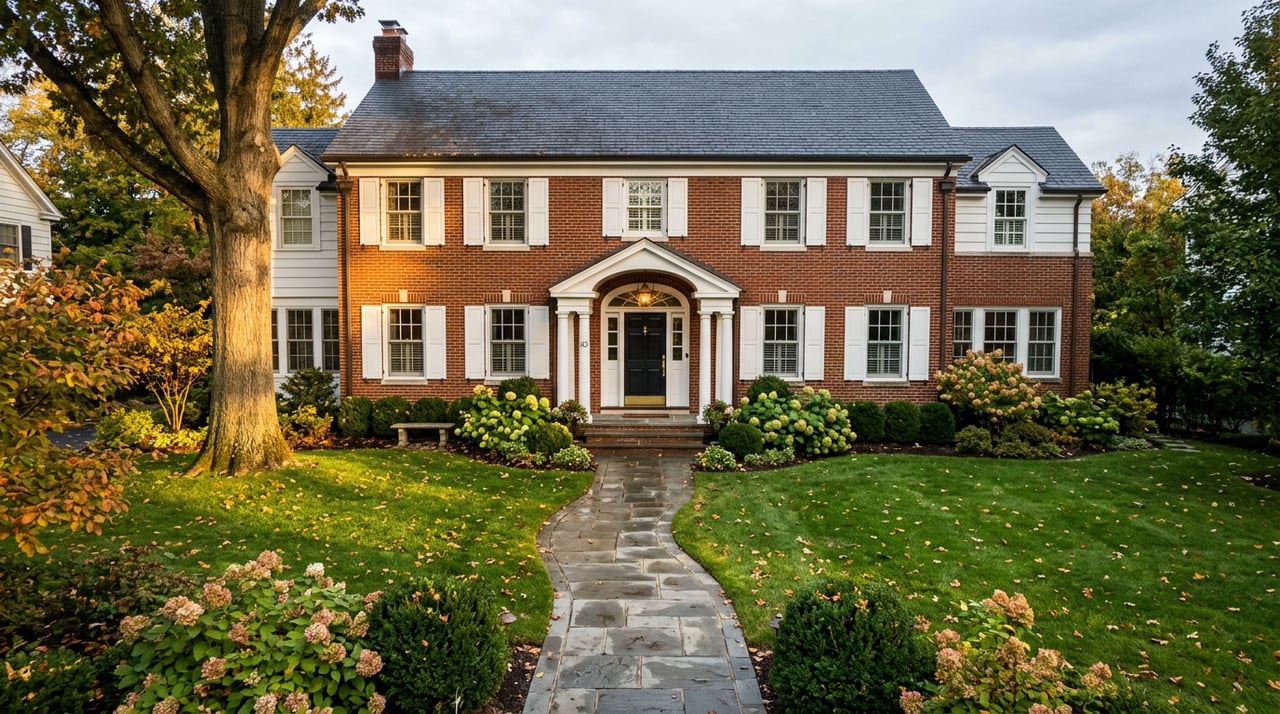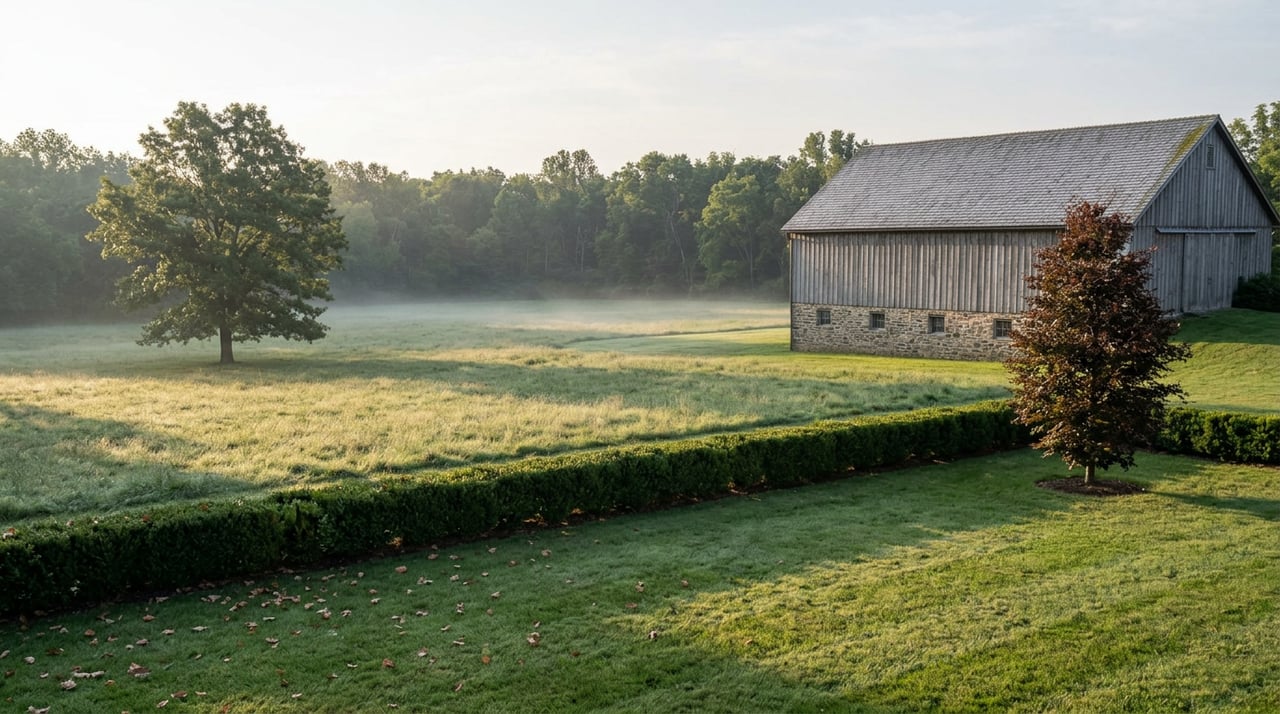
A stone manor on Private Road in Peapack Gladstone Boro is currently listed at $14 million. It was built in 1931 by New York architect Musgrave Hyde, clad in locally quarried stone, and has hosted the Essex Fox Hounds Thanksgiving Day Meet since the early 1930s. Buried near the bottom of the listing sheet, after the pool house and the ten-stall stable and the note that showings require a financial reference letter, sits one plain sentence: the property is farmland assessed.
That sentence is worth more to a buyer than almost anything else on the page. It means a large share of the land under that $14 million house is not taxed like a $14 million lot. It is taxed like a farm. And whether that stays true after closing is not automatic. It is a status the new owner has to keep earning, under rules that just got stricter.
If you are comparing a Peapack and Gladstone estate against something similar in Bedminster or Far Hills, the sale price is the least useful number you will look at. The one that actually determines what you will pay every year is whether, and how much of, the parcel qualifies under New Jersey's Farmland Assessment Act.
The Median Everyone Quotes Isn't Measuring Much
Before getting to the mechanism, it is worth being honest about why the price comparisons buyers usually run against neighboring towns fall apart here. Peapack and Gladstone sells so few homes in a given month that a single closing can swing the headline number by triple digits.
As of July 2026, one national listing site put the borough's median home price at $4.1 million while its trailing twelve month median sale price sat at $840,000, a gap wide enough to make both numbers nearly meaningless on their own. Separately, another portal reported that in January 2026 the median sale price ran $2.7 million, up more than 200 percent from the year before. None of those figures are wrong. They are just describing a market where two or three closings a month can make the town look like it doubled or halved in value overnight.
That volatility is a symptom, not the story. In a market this thin, town-wide averages tell you almost nothing about what a specific estate will cost to hold. The parcel-level facts do. And the biggest parcel-level fact in Peapack and Gladstone is whether the land qualifies as farmland under state law.
What "Farmland Assessed" Actually Buys You
New Jersey's Farmland Assessment Act lets land that is actively devoted to agricultural or horticultural use get taxed on its farming productivity value instead of its market value. The house and its immediate homesite are still assessed like any other residential property. It is the acreage around the house, the pastures, the paddocks, the hayfields, that can qualify for the reduced rate, and the reduction is not small. A parcel that would otherwise carry a market-rate tax bill can see the land portion of that bill cut by 90 percent or more once farmland assessment applies.
To qualify, a property needs at least five contiguous acres in agricultural or horticultural use, and the owner has to show gross sales or income from that use, historically at least $1,000 a year for the first five acres plus $5 for each additional acre. The paperwork, Form FA-1 and, where woodland is involved, Form WD-1, has to be filed with the municipal assessor by August 1 of the year before the tax year in question. Miss the filing or fall short of the income threshold, and the assessor can deny the application.
Why This Is Peapack and Gladstone's Story
This is not a rule that shows up evenly across Somerset County. It matters most in a place where large lots, working pastures, and an actual equestrian economy sit side by side with seven and eight figure houses. Peapack and Gladstone is that place. The borough is home to Hamilton Farm Estate, where the United States Equestrian Team trains horses and riders, and it sits partly within Natirar, the former estate whose 247 acres in the borough are now parkland after passing through ownership that once included the King of Morocco. The Essex Fox Hounds hunt still meets on estate grounds that have hosted it for close to a century.
That heritage is not just scenery. It includes boarding fees, hay sales, and the kind of working pasture a hunt property needs to maintain.
The Bar Just Moved
The rules governing that qualification are not static, and buyers evaluating a farmland-assessed estate right now are stepping into a system mid-change. In August 2025, the state's Farmland Evaluation Committee voted to raise the minimum gross sales threshold from $1,000, a figure set back in 2013, to $1,900, phased in over three years, according to NJB Magazine. In January 2026, the Office of the Governor of New Jersey reported that Governor Murphy signed bipartisan legislation requiring the committee to periodically revisit that threshold going forward, rather than letting it sit untouched for another decade. The reform also adds a new online application portal set to launch for Tax Year 2027, along with stiffer penalties for misrepresenting farm activity on an application.
| Before the 2026 reform | After the 2026 reform | |
|---|---|---|
| Minimum contiguous acreage | 5 acres | 5 acres, unchanged |
| Minimum gross sales, first 5 acres | $1,000 (set in 2013) | $1,900, phasing in over three years |
| Threshold review process | No required periodic review | Committee must periodically adjust |
| Application filing | Paper Form FA-1 by August 1 | Online portal launching for Tax Year 2027 |
For a buyer inheriting a farmland-assessed parcel, this means the income a property needs to generate to keep its status is going up, and the state is building a system specifically designed to catch applications that do not hold up to scrutiny. A boarding or hay operation that cleared the old $1,000 bar with room to spare might sit closer to the line under the new number.
What Happens If the Status Lapses
If a farmland-assessed parcel changes use, the owner owes what New Jersey calls rollback taxes: the difference between what was paid under the farmland rate and what would have been owed at full market value, assessed for the year the change happens plus the two years before it, according to MROD Law. On a large, high-value parcel in a town like Peapack and Gladstone, where the gap between farmland value and market value is wide, that difference can add up to a serious bill arriving all at once.
New Jersey's tax courts have drawn a real distinction here that works in a buyer's favor. In Flemington Trade Center v. Township of Raritan, the state's tax court reinforced that simply stepping back from active farming is not enough to trigger a rollback. The state has to show an actual change of use, not just a quiet year. Still, it is not a fight anyone wants to have after closing.
The Question to Ask Before You Compare Two Estates
Comparing a Peapack and Gladstone listing to something similar in a neighboring town on price alone skips the part of the transaction that actually determines the carrying cost. Before treating two estate-priced homes as equivalent, a buyer should be asking the seller or listing agent:
- Is any portion of this lot currently farmland assessed, and how many acres does that cover
- What is the current qualifying use, and has it consistently met the gross income threshold
- Has Form FA-1 been filed on time each year, and is there any history of denial or appeal
- What would the land tax look like if that use stopped entirely
None of this replaces a conversation with the municipal tax assessor or a New Jersey tax professional before you rely on any number, since assessment values and qualifying activity can shift year to year. But knowing which questions to ask before you fall in love with a hayfield view is the difference between an accurate comparison and a surprise on your first full tax bill.
If you are weighing an estate purchase in Peapack and Gladstone against something in Bedminster, Far Hills, or elsewhere in the Somerset Hills, the price per square foot only tells part of the story. Brown & McCrea works this market regularly and can walk through what a specific parcel's assessment history actually means for your budget before you make an offer. Contact us to talk through what a particular listing's acreage is really costing its current owner, and what it would cost you.
This article is general information, not legal, tax or financial advice. Consult a qualified professional about your situation.